Customizing additional parameters |


|
|
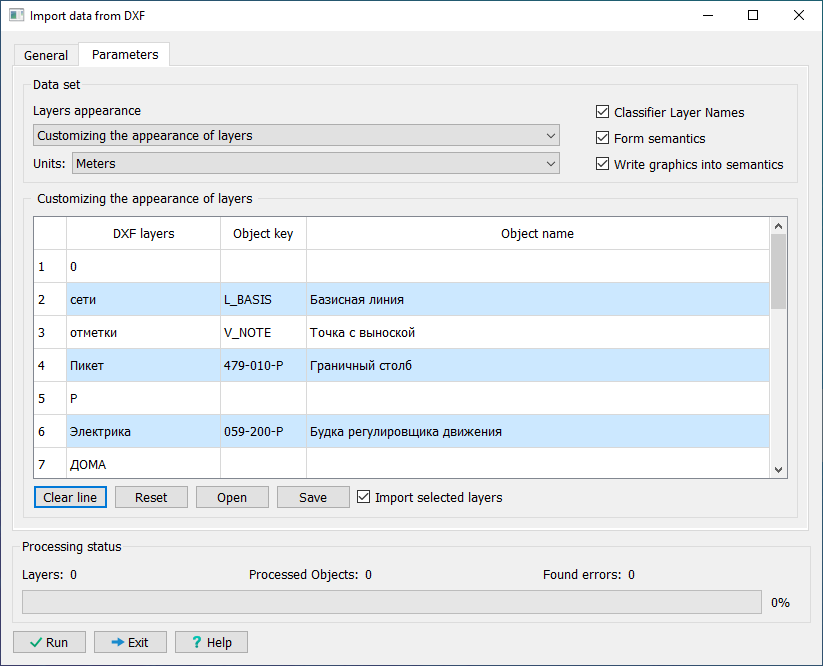
The procedure dialog box contains the Parameters tab, designed for the primary configuration of the import project.
Procedure dialog box. Parameters tab
The settings configured on this tab are saved to the project file and used during subsequent batch processing runs.
Data Loading Types The import procedure supports two options for loading vector data: • Loading while preserving the graphic appearance of objects; • Loading according to the map classifier (with object re-encoding). The choice of loading type determines the method for forming the graphic and semantic description of objects in the output map.
Loading while preserving the graphic appearance of objects In this mode, the appearance of objects as specified in the input data is preserved. To configure the appearance, select a mode from the Layer Appearance dropdown list: Fill or Outline. Ensure that the objects in the input dataset do not have a classification code and contain a graphic description (color, line type). During import, line types are adjusted: • Appearance preserved: solid, simple dashed, and simple dotted lines. • Replaced with a dashed line: dash-dot, complex dashed, and complex dotted lines. • Replaced with an offset dash: complex lines with symbols or signs. The following hatch types are supported: • Grid with a 90° step; • Vertical lines; • Horizontal lines. Other types of hatching are not generated during import. When loading in outline mode, object filling and hatching are not performed.
Adding Semantic Information 1. To load objects with added semantics, enable the Load with semantics addition mode. 2. Ensure that the input objects contain text attributes used as semantic values (e.g., labels). 3. Set the source for the semantic value: • name of the input data layer; • name of the map layer (depending on the state of the Layer Names by Classifier toggle). Before performing the load, it is recommended to edit the map classifier, using the names of the input data layers as object identifiers.
Processing Composite Objects (Blocks) Objects formed based on compound descriptions receive the Proper Name semantics upon import. When processing such objects, the block name is used as the semantic value. If the semantics allow repetition, the following are additionally saved: • block name; • layer name; • line type; • other input data parameters. For subsequent object re-encoding, editing of map objects using the loaded semantic values is allowed.
Loading according to the map classifier with object re-encoding This mode is used to conform input data to the structure of the map classifier. Matching is possible by Object Name or Object Key. Ensure that the names of the input data layers correspond to the names or keys of objects in the classifier, or that the map classifier has been edited so that object names match the names of the input data layers. During import, objects are automatically assigned classification codes. The graphic appearance of the input data is not preserved, as the description from the classifier is used instead.
Configuring the correspondence between layers and classifier objects 1. For manual configuration of correspondence, go to the Parameters tab. 2. In the Layer Appearance field, select the Layer Appearance Settings Table mode. 3. Assign the corresponding conventional symbol from the classifier to each input data layer. 4. Enable the Import selected layers parameter so that only layers with specified settings are loaded. 5. The configuration result is saved in a parameters table named <classifier_name>.cus. This table is used during subsequent object re-encoding. The Units of Measurement field is intended for selecting the coordinate units of measurement of the source file. |