Sorting and data compression |


|
|
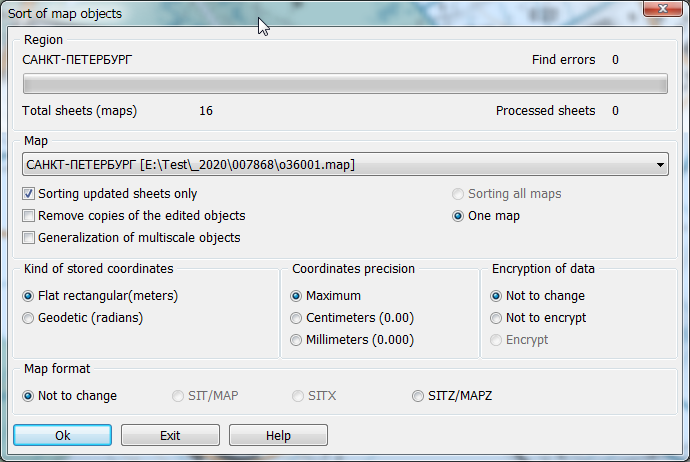
After an execution of any procedures changing the metric or semantic description of objects of a vector map (editing, updating, control, import of data, and also at editing the classifier if the order of displaying objects on a map is changed) - is recommended to carry out procedure of data sorting. Procedure of sorting orders the placement of object descriptions in files of the metrics and semantics that accelerates their further processing and provides correct sequence of displaying objects. Besides, created files do not contain the description of the metrics and semantics of the removed objects and a copies of the edited objects. Thus, compression of data is carried out. Sorting of map objects can change precision of a data storage (the number of decimal places after a comma) and system of saved coordinates of objects - flat rectangular in meters or geodetic in radians. Storing coordinates in radians accelerates display of maps when it is required to carry out recalculation in different projections of display «on the fly», and allows to create maps of any length in a longitude. Storage of coordinates in meters essentially accelerates display of a map in its own projection. For correct formation of the land-surveying documentation, calculation of lengths, the areas, the list of coordinates, etc. in addition it is recommended to install precision of storage in millimeters or centimeters. That will provide uniformity of results of calculation in all tasks (Geodesy editor, Map Editor, Calculations on a map, etc.) without additional parameters setting. If the mode is used Sorting updated sheets only, sorting will be carried out only for those sheets on which objects were edited. It reduces time of sorting. If the mode is used Remove copies of the edited objects, then after sorting it is impossible to restore the objects deleted or edited earlier. Thus the size of data on a disk decreases. If the Generalization of multiscale objects mode is enabled, then for objects of the RSC classifier having the Multiscale property, additional contours will be built by the generalization method. Sorting enables the format conversion of a vector map.
Multisheet Map consists of a map passport (MAP file) and individual files for each sheet: metric data (DAT), semantics (SEM), index file (HDR), graphic objects (DRW), and display weight table (SIN). User Map consists of a map passport (SIT file) and data files: metric data (SDA), semantics (SSE), index file (SHD), graphic objects (SDR), and display weight table (SIN). The display weight table (SIN file) is created automatically when sorting a map or when creating maps in MAP, SIT, or SITX formats. It is required for automatic ordering of objects according to the display sequence specified in the RSC classifier. In the absence of the SIN file, objects are written solely based on localization type (e.g., linear objects above polygons, point objects above linear ones, etc.). A User Map and a single-sheet Multisheet Map can be stored as a single SITX file. The data volume in the SITX file may be 5–10% larger than when stored across multiple files. The SITX format simplifies data management on storage media and enables access restriction via 256-bit encoding. Access to encoded data is granted upon entering a password. Both Multisheet Maps and User Maps can be packed into a single compressed file. A packed Multisheet Map has the MAPZ extension, while a packed User Map has the SITZ extension. To achieve higher compression, metric accuracy is automatically reduced to centimeters. The compressed data volume decreases approximately threefold compared to the original data at maximum metric accuracy. Data decompression occurs in memory as the corresponding sheets and objects are being read. If the entire map sheet fits into memory, it is decompressed in multithreaded mode upon opening the sheet to accelerate access. Packed maps are read-only. When sorting with format conversion, the original map files are automatically deleted. SITX, SITZ, and MAPZ formats can be converted back to the original SIT or MAP formats by sorting. During such reverse conversion, packed maps retain metric accuracy in centimeters. Object coordinates stored in centimeters are kept as integers, reducing metric file sizes by half. When deploying data on spatial data servers, it is advisable to use the MAP and SIT formats to reduce access time. In desktop applications, the choice of format depends on the need for data encoding, simplifying data exchange with fewer files, ensuring storage compactness, and other factors.
|