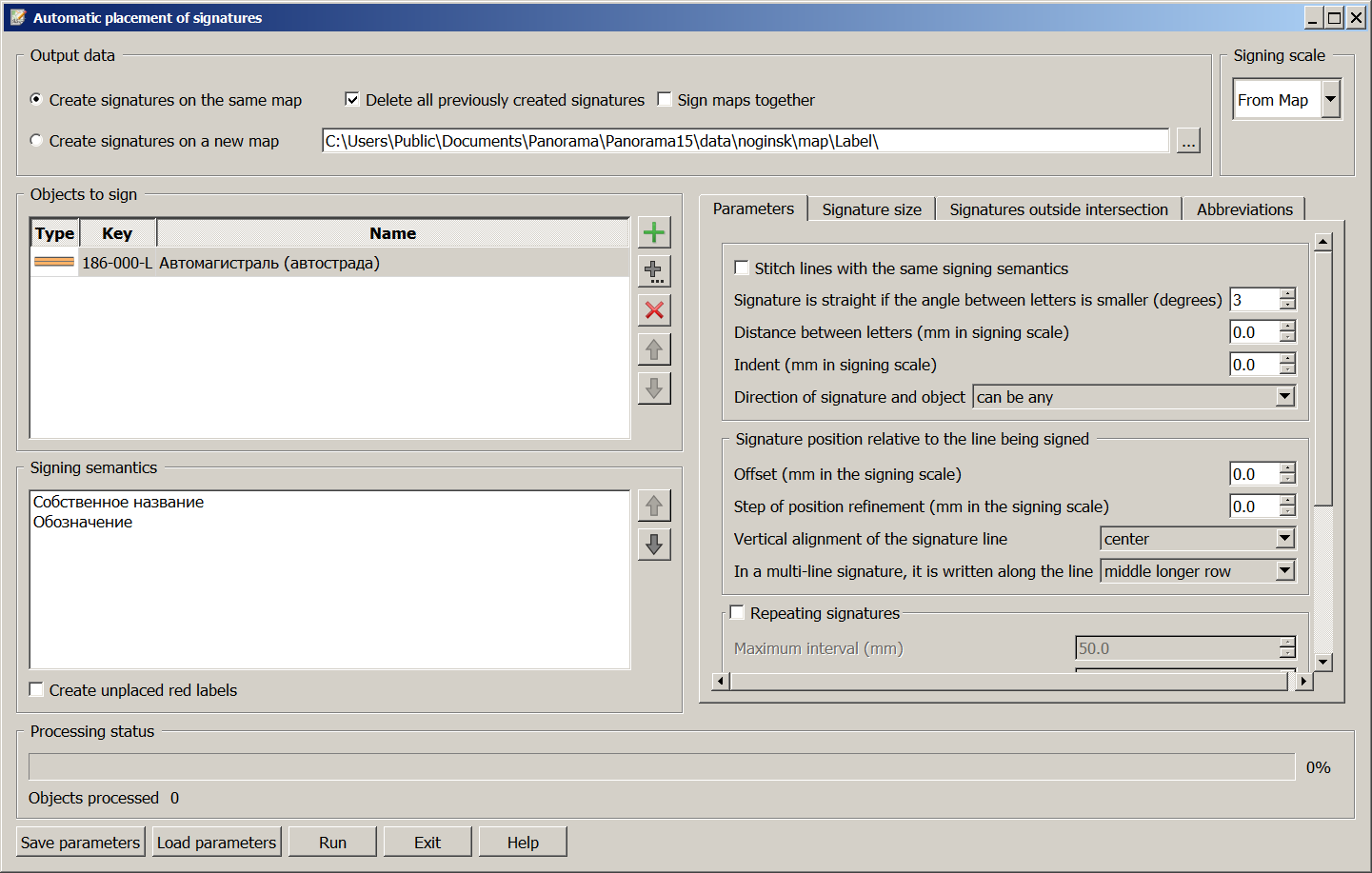
Main parameters for labeling linear contours |


|
|
When enabling the Stitch lines with the same signing semantics mode, lines with identical labeled semantics are preliminarily merged before applying labels. It should be noted that during merging, contours may close. This occurs when labeling river names along shorelines when watercourse area objects don't contain names.
Usually, linear objects are labeled along the contour. The For closed contours create labels along axis line mode allows labeling rivers and background multi-contour strips along the centerline. Background multi-contour strips can be loaded when importing from external formats (SHP, MIF/MID).
The metrics of the created label will consist of only two points if all letters appear to be practically on one straight line. The tolerance determining which labels are considered practically straight is entered in the field Signature is straight if the angle between letters is smaller. If the angle between letters exceeds the specified tolerance, a sub-object with two points in metrics will be created for each letter of the label. Such labels are called composite (curved). When entering the Distance between letters parameter, created labels will have spaces between letters.
Indent determines the label's displacement from the beginning and end of the contour. Protrusion extends the labeled contour at the beginning and end. Typically, protrusion is used when applying labels along the centerline of closed contours of background strips. Background strips correspond to areas containing labels in external formats (SHP, MIF/MID). Strips can have one or multiple contours. The centerline of a strip set is calculated automatically.
Direction of signature and object determines labeling in arbitrary, forward, or reverse direction relative to the object's metrics. Usually, contour labeling is performed in an arbitrary direction. Forward and reverse direction labeling can be used for labeling boundary contours of adjacent territories when one semantic contains the name of the territory located to the left of the contour, and another semantic contains the name of the territory located to the right of the contour.
|