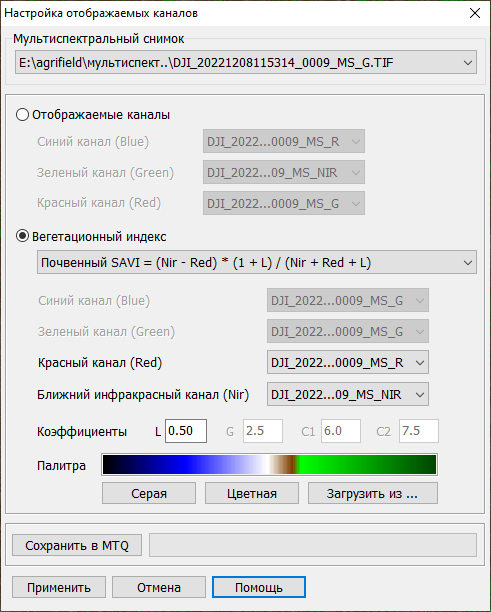
Customizing displayed channels of multispectral image |


|
|
Dialog allows to customize display of multispectral raster images. Two modes of displaying are accessible: • RGB mode; • vegetation index.
In RGB mode it is necessary to specify numbers of the channels corresponding to blue, green and red colors. Numbers of channels are specified by the manufacturer of the camera. Sometimes it is useful to choose a different combination of channels to highlight the desired characteristics in the pictures. You can disable a channel by selecting «No» in the list of available channels. The vegetation index (VI) is an indicator calculated from the brightness values in different spectral ranges that characterizes the state of vegetation. Usually, red (RED) and infrared (NIR, near-infrared) channels are used to assess vegetation. These channels contain information about the degree of light reflection by chlorophyll.
The calculated index is displayed by color from a palette. It is possible to use the predetermined grey or color palette, or to load it from RSW or MTQ.
The calculated vegetation index value is converted into a palette index by linearly interpolating the valid range of vegetation index values to a range from 0 to 255 (255 is the number of colors in the predefined grayscale and color palettes; for a loaded palette, the number of colors may vary). For example, for NDVI, palette color 0 corresponds to a vegetation index of -1, and color 255 corresponds to a vegetation index of 1. Only for RVI is a nonlinear transformation used: RVI from 0 to 1 corresponds to palette color range from 0 to 127; RVI from 1 to 255 corresponds to palette color range from 127 to 255. The image with the current settings can be saved to another file. In RGB mode, the image is saved in RSW format with a color depth of 24 bits (8 bits per 3 channels). The vegetation index is saved to an MTQ quality matrix, which stores the actual vegetation index value without mapping it to the palette range. All settings are applied to the image immediately after being changed. Clicking the Apply button saves the settings and closes the dialog. Clicking the Cancel button closes the dialog and reverts to the settings that were in effect when the dialog was launched. If multiple multispectral images are open, their display can be configured jointly (by default), or the desired image can be selected from the Multispectral Image list. |